EU digital spray logbook: new obligations from 2026 and 2027
From 2026 onward, the European Union will introduce new rules for recording plant protection product (PPP) applications. While many winegrowers still work with paper spray books or scattered Excel files, the EU is moving decisively toward electronic, machine-readable registration.
This is not bureaucracy for its own sake: the goal is stronger control, better traceability, and more sustainable use of crop protection products.
In this blogpost we explain what changes on 1 January 2026, what becomes fully mandatory by 1 January 2027, and how we at Trace your Craft/ Tastefever have already prepared the ERP platform to make this transition easy—and actually reduce admin.
1. What does EU legislation say?
1.1. Spray registration was already mandatory
The obligation to keep spray records has existed for years under Article 67 of Regulation (EC) 1107/2009. Professional users must record which product was used (name), when (date), on which crop and parcel, and at what dose.
Until now, Member States could allow paper or digital formats. That is changing.
2. Mandatory from 1 January 2026: digital and standardized
With Implementing Regulation (EU) 2023/564, the EU sets a new standard. Spray records must be:
- kept electronically,
- in a standardized format (machine-readable),
- using a predefined set of mandatory data fields, with additional mandatory fields to be recorded from 2026 onward.
Why? The EU explicitly states that electronic records are more reliable, easier to verify, and allow uniform enforcement across all Member States.
2.1. What must be included in the digital spray logbook?
The regulation specifies that each application must include, among other things:
- identification of the PPP/product (trade name + authorization number)
- date and start time of application
- dose and quantity used
- treated area and location/parcel (if possible with official codes of the parcel)
- Crop type (with EPPO code); for viticulture, this code is VITVI.
- Crop growth stage, preferably referenced using the BBCH system
- user/operator
For winegrowers, this means: every treatment must be recorded per parcel, digitally, and in an exportable structure that inspectors can retrieve.
3. Transition period until 1 January 2027
Because not all Member States were ready to switch immediately, the EU introduced a short transition period through Implementing Regulation (EU) 2025/2203. In practice, this means that records for applications carried out before 1 January 2027 may still be kept temporarily outside the standardized digital format, as long as they are later brought into compliance. From 1 January 2027 onward, however, the standardized electronic register becomes mandatory for everyone without exception.
The legislation requires every spray application to be recorded within seven days of being carried out (a rule that already applied before 2026). Records must be kept electronically in a machine-readable register, and any treatment initially written on paper still has to be entered into the official digital format within thirty days after use.
So the timeline is clear: starting 1 January 2026, electronic standardized recording becomes the rule, and by 1 January 2027 the transition ends and full digital compliance applies across the EU.
4. What does this mean for winegrowers?
For many estates this is a real operational shift:
- Paper spray books will no longer be sufficient, except as temporary field notes that must be digitised shortly after.
- Unstructured Excel lists will not be compliant; any Excel-based register must follow the EU format and include all required data fields.
- Records must be parcel-based and include all mandatory EU data fields
- There will be stronger focus on traceability (what was used, when, where, and why).
If you already register digitally in a system aligned with EU fields, you’re doing a great job.
5. What Trace your Craft/ Tastefever has already prepared
Because digital traceability and administrative simplification are core to our ERP platform, we didn’t bolt this on later—we built it in naturally.
5.1. EU-compliant digital spray logbook
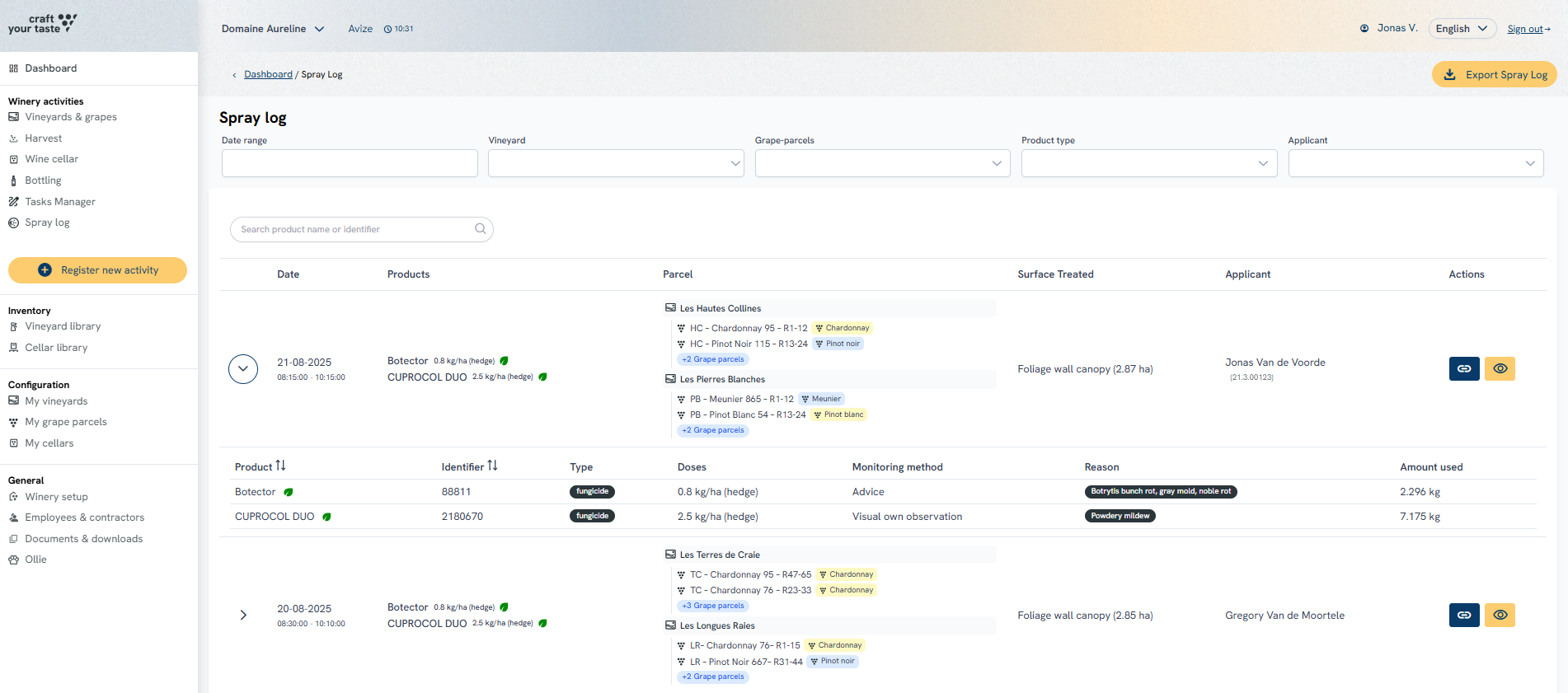
Inside the platform, every treatment can be recorded with all required EU fields:
- product selection from your approved product list (with authorization info),
- direct link to the right parcel/plot within your vineyard structure,
- automatic calculation of dose per ha / treated surface (coming start 2026),
- date, operator, and context (purpose, notes).
All data is stored in a uniform exportable format, so you’re ready instantly for audits or inspections.
5.2. Less admin, more certainty
Going digital does not add work—it reduces it:
- No double entry: one input feeds your logbook, stock usage (coming start 2026), traceability and reporting.
- Error prevention: the system flags missing fields or abnormal doses.
- One-click reporting: yearly spray summaries per parcel/crop in seconds.
- Always searchable: no lost notebooks, wet papers, or unreadable handwriting.
5.3. Ready for what comes next (IPM, indicators, audits)
The EU is using digital logbooks to build broader sustainability monitoring. By recording in a structured way now, you are already prepared for:
- IPM justification,
- sustainability and product-use indicators,
- easy sharing with advisors or cooperatives,
- future integrations with EU and national systems.
6. Why starting now is the smart move
2027 may feel far away, but spray data is generated during the season. If you only switch at the end of 2026, you lose a full season of compliant digital history.
That’s why we recommend:
- start digital recording already in 2026,
- build a complete history,
- enter 2027 with a workflow that’s already second nature.
Conclusion
The EU is making digital spray records a Europe-wide standard:
- From 1 January 2026, spray registration must comply to the new mandatory fields
- From 1 January 2027, the digital format is mandatory everywhere without exceptions.
Trace your Craft/ Tastefever is already compliant and ready: the digital spray logbook is fully integrated into the ERP platform, including all EU data fields, export formats, parcel-based traceability, and built-in validation.